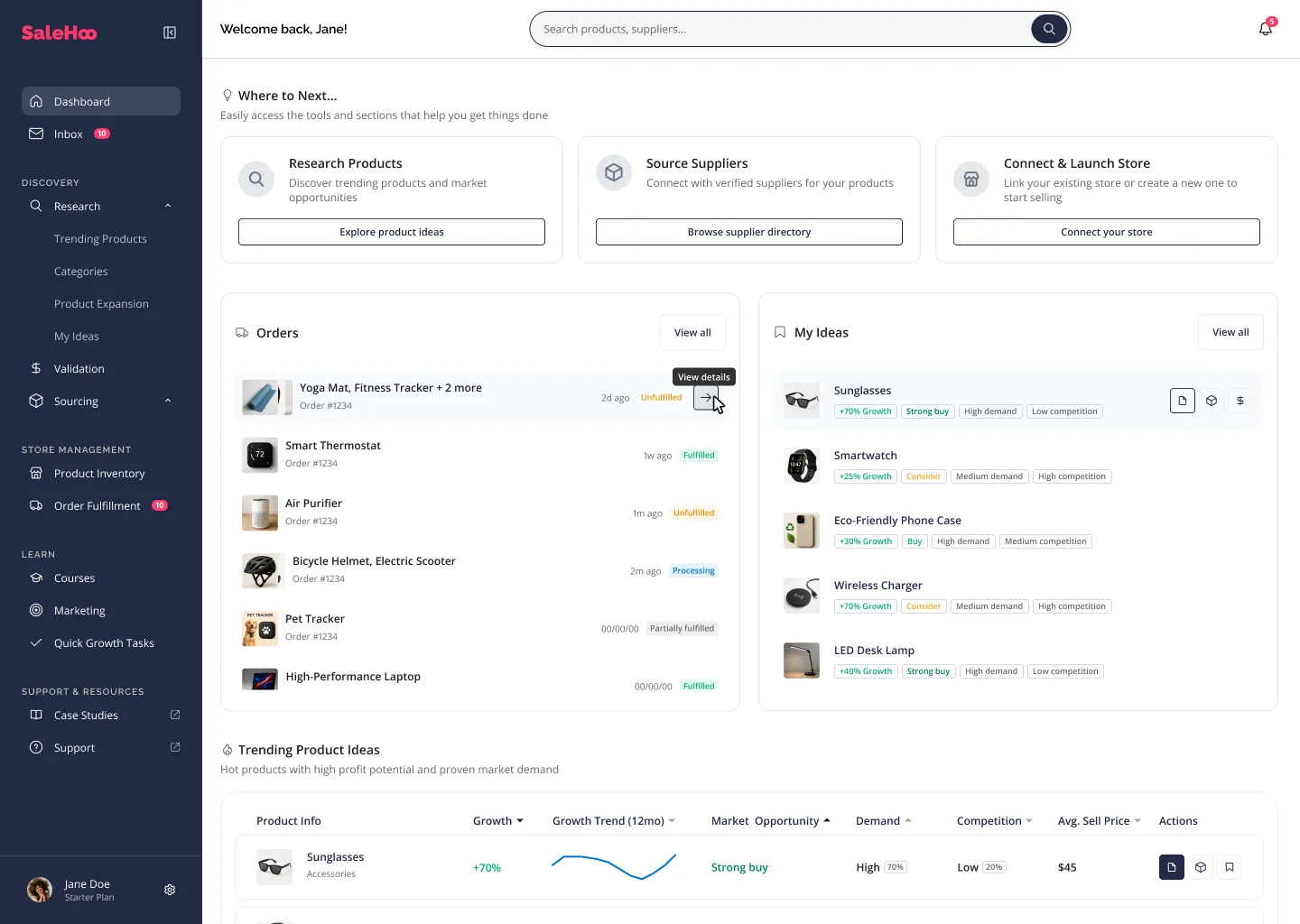
SaleHoo brings supplier search, product research, some Shopify workflows and training into a paid eCommerce toolkit. It can shorten the search for potential suppliers—but membership is not a substitute for sampling products, checking fulfillment terms or validating demand.
One place to begin supplier search, research and basic training.
Paid access, variable supplier fit and Shopify-specific native automation.
| Question | Documented source | What remains unverified |
|---|---|---|
| Are membership plans offered? | Current vendor pricing page | Individual checkout and taxes |
| Does a supplier directory exist? | Vendor directory descriptions | Niche-specific quality and response rates |
| Is Shopify automation offered? | Published product and integration help | Actual order, stock and return workflow |
| Does membership improve profit? | No reliable public result established here | Your market, costs, sourcing and acquisition outcomes |
| Can a buyer obtain a refund? | Advertised policy and support instructions | Outcome of an individual eligible request |
Quick verdict: who might benefit
A beginner who wants a structured shortlist of wholesale and dropshipping suppliers may find a curated directory easier to navigate than an open web search. Shopify sellers who value automated product imports should investigate SaleHoo Dropship separately from the general Supplier Directory.
A business sourcing a niche product with strict compliance rules, a store outside Shopify needing automatic fulfillment, or a team with an established supplier network may not recover the subscription cost. We have not independently tested account performance or measured user profit outcomes.
What you actually get
The public website describes an 8,000+ pre-vetted supplier directory, product research features, seller education and Shopify-specific dropshipping automation. These are SaleHoo-reported product claims, not outcomes validated through a paid account.
The key distinction is between discovery and operations. A supplier profile can introduce a contact; you still need to agree on landed costs, minimum orders, stock feeds, return handling and service levels. Automation features and quotas depend on the plan and the SaleHoo module used.
Strengths and practical drawbacks
Potential strengths: a broad starting database, filters that can reduce unstructured research time, plan options and education for first-time sellers. The published directory includes both wholesalers and dropshippers.
Tradeoffs: it is a paid service, listed suppliers still require independent due diligence, no supplier is guaranteed to approve every reseller, and native Dropship automation is Shopify-only. Publicly advertised product counts or profit language should not be taken as a guarantee of sales.
Pricing, terms and true total cost
The vendor currently lists Starter at $9 per month billed annually and Pro at $49 per month billed annually, plus separate lifetime purchase choices. Consider other business costs: Shopify or marketplace fees, samples, domain, advertising, payment processing, returns and fulfillment.
SaleHoo advertises a 60-day refund window. Before buying, inspect the terms on the checkout page, keep the receipt, and check renewal and cancellation deadlines. See the dedicated price and refund guides for arithmetic and support links.
How we evaluate it
We examine public plan tables, support documentation, integration statements and the supplied product interface imagery. We have not logged in to a live paid account, sent test orders or audited individual suppliers. Our assessment separates vendor claims from independently applicable sourcing principles.
A sensible buyer experiment: identify ten suppliers for your niche, request real samples and terms, calculate landed contribution margin and test your integration workflow before allocating substantial advertising spend.
Evidence register: what has and has not been established
The existence of a published supplier directory, documented subscription plans and Shopify integration guidance can be checked against vendor pages. That establishes what is advertised, not how reliably every feature performs in a particular store. A supplier count is a coverage claim; it is not a count of suppliers suitable for your niche, country, compliance obligations or shipping service level.
The screenshots on this website were supplied for promotion. They help readers understand the appearance of the interface, but they are not recordings of our own paid-account testing. We have not independently benchmarked supplier response rates, completed a SaleHoo-sourced order, tested a refund request or verified member revenue claims. Those unknowns remain part of the buying decision.
For a practical evaluation, distinguish four kinds of evidence: (1) publicly documented functionality; (2) vendor statements that may change; (3) independent examples or customer reports that must be examined for source quality; and (4) first-hand testing of an actual supplier and fulfillment route. A confident purchase decision should not depend on silently treating category one or two as category four.
The seven questions to answer before paying
First, define your product category and the countries where you intend to buy and sell. Second, determine whether you need wholesale purchasing, supplier-fulfilled dropshipping, private label production or a combination. Third, identify the practical supplier search filters you cannot easily replicate with ordinary web research.
Fourth, map out the true working costs: the membership fee, samples, freight, duties, inventory commitment where relevant, payment fees and customer acquisition. Fifth, compare plan limits with your actual number of stores, supplier contacts and product imports. Sixth, read the checkout and cancellation terms at the moment you buy. Seventh, specify how you will judge usefulness during the applicable refund window—such as finding three independently vetted suppliers that meet written criteria.
These questions are more predictive of personal fit than promotional phrases such as “winning products.” A directory may be valuable to one operator and redundant for another. Strong purchasing evidence is narrow, operational and repeatable.
Who should consider an alternative
A merchant with established manufacturer relationships may already have a dependable supply pipeline. Paying for a broad directory might add little if no new supplier can improve cost, quality or delivery. A store that depends on an unsupported platform should confirm each supplier’s feed and order process rather than assuming the Shopify-oriented Dropship integration solves its requirements.
A newcomer with no test budget should also separate the cost of access to information from the cost of launching a store. Even a useful research tool cannot fund samples, compliant product listings, returns or marketing. In that situation a narrower manual sourcing experiment can be more informative than buying every available tool at once.
The most reasonable favorable case is a seller who needs searchable supplier coverage, wants structured research support, understands the operational limitations and has a budget to verify suppliers independently. This is a suitability assessment—not a promise of profitability.
Questions buyers ask
Have you independently used a paid SaleHoo account?
No. This review evaluates public vendor material, integration documentation, support policies and supplied screenshots. We have not performed live supplier transactions or audited the platform from a paid account.
Does a SaleHoo membership guarantee profitable products?
No. Vendor listings and research tools cannot eliminate advertising, product compliance, returns, shipping or pricing risk. An actual business requires independent validation and customer acquisition.
Is this website the official SaleHoo website?
No. Sourcing Atlas is independently branded and affiliate-funded. For purchase and billing support, use SaleHoo’s official site and support channels.
The most reliable way to evaluate a sourcing product is to match its limitations to your actual business workflow.
Review our supplier checklist →References & fact-check sources
SaleHoo product specifications are taken from vendor materials. General sourcing advice is our editorial interpretation, not an account-level performance test.
Compare the current SaleHoo offering
Check the latest product details directly with the vendor. This is an independent site.